| Author |
 Topic Topic  |
|
|
MullyFX
Gold Member

Germany
753 Posts |
 Posted - 07/21/2009 : 18:16:58 Posted - 07/21/2009 : 18:16:58


|
Okay... not really a Boss only question but a technical one.
So I have several stereo-out(dry+wet) pedals... but currently am only running a mono-amp setup with just one input on the amp.
Now if I want to process the dry signal differently than the wet signal (hende the mix out is neglected) what is the best (and hopefully easiest) way to sum those signals back together...??
I figure a Y - cable should do but since I'm unsure I thought I'd ask.
cheers,
mully |
|
|
Laurie
Double Platinum Member

Canada
4854 Posts |
Posted - 07/21/2009 : 18:26:09
|
Hi Mully!
It will need to be a mixer - a y-cable may actually damage the pieces of gear connected.
Splitting a signal (one signal into two pieces of gear) can be done with a y-cable, but combining (two signals into one piece of gear) needs a mixer.
The LS-2 will do the job - one signal into "Return A" and the other into "Return B", and set the pedal to "A+B Mix".
Another solution would be a really small (second hand) mixer - say a Behringer 602.
I'd use the "loop mixer" pedal I designed, of course 
|
 |
|
|
IM28
Copper Member
26 Posts |
Posted - 07/22/2009 : 03:01:44
|
| The easiest way is to use a resistive mixer. DOD used to make a 4 channel one you can pickup for cheap. Some amps,notably Fender have two input jacks per channel that when both are used the inputs are summed using resistors. The best way is to use an active mixer to sum the signals and provide active gain recovery. Boss used to make several models like the KM-4 or BX-4 that can be found for not too much used. These are small 9V powered mixers that can fit on a pedalboard. |
|
|
|
MullyFX
Gold Member
Germany
753 Posts |
Posted - 07/22/2009 : 16:35:23
|
Thanks guys,
I'll try to score the KM-4 that's on ebay right now.. am not planning to spend much though |
|
|
|
natthu
Gold Member
Australia
756 Posts |
Posted - 07/23/2009 : 09:39:16
|
Hey Mully,
This is the resistance mixer I think IM28 is talking about:
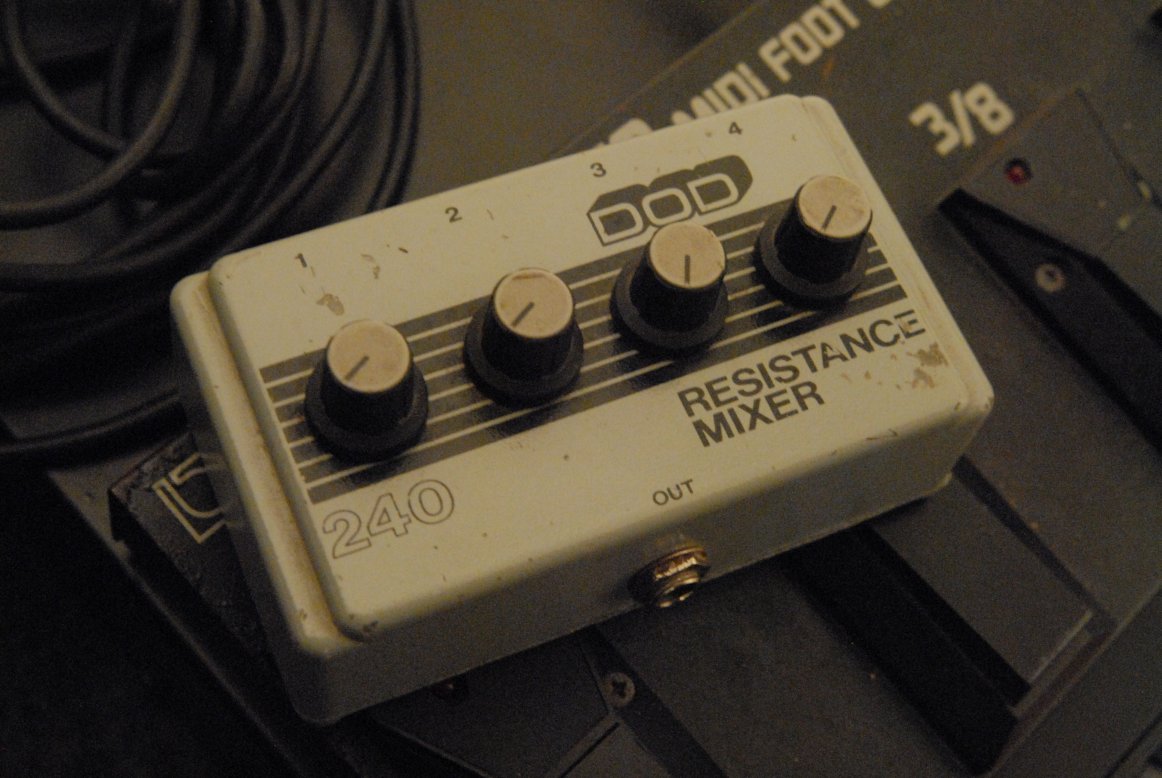
They're pretty handy... and quite cheap.
I also have a small powered 2-channel mixer for when I want to maintain the stereo chain:
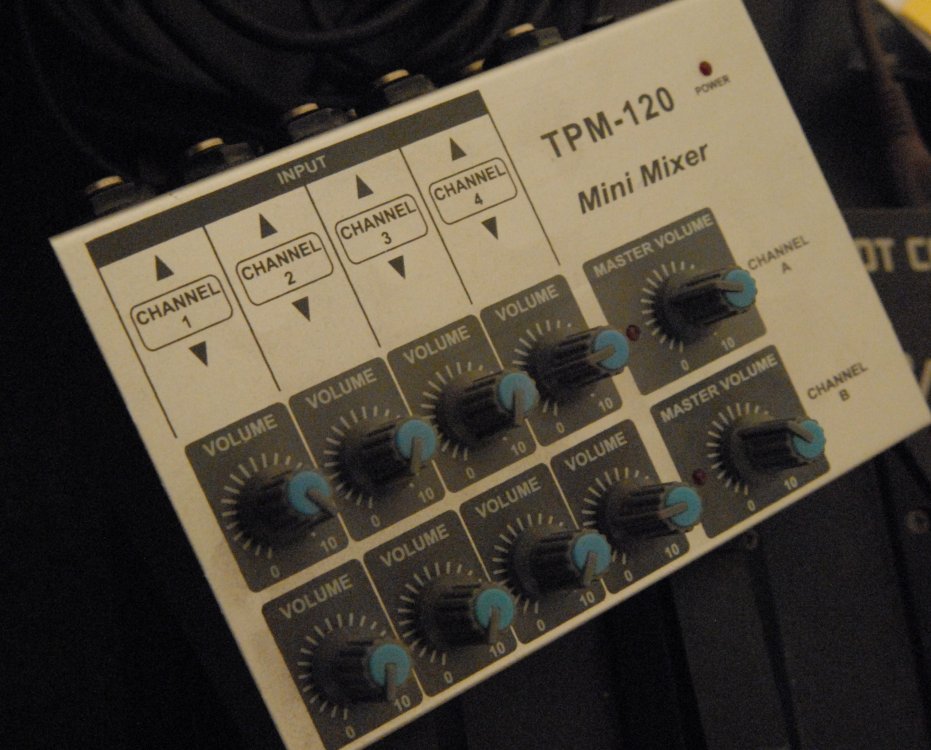 |
|
|
|
Laurie
Double Platinum Member
Canada
4854 Posts |
Posted - 07/23/2009 : 13:07:39
|
| I would recommend against a resistance mixer. |
|
|
|
natthu
Gold Member
Australia
756 Posts |
Posted - 07/23/2009 : 14:40:40
|
quote:
Originally posted by Laurie
I would recommend against a resistance mixer.
Well now you've got me in suspence... Why do you recommend against a resistance mixer? Am I hurting my pedals? |
|
|
|
Laurie
Double Platinum Member
Canada
4854 Posts |
Posted - 07/23/2009 : 14:52:26
|
| Probably not, but it won't manage the impedances properly and certainly won't sound as good as an active mixer. |
|
|
|
IM28
Copper Member
26 Posts |
Posted - 07/24/2009 : 15:05:54
|
Yeah a resistance mixer is most useful if the pedal going into the mixer has an output level control, like an overdrive, this lets you overcome any losses imposed by the resistive mixing. Effects without output level controls loose signal level going thru the resistive mixer. an active mixer lets you cut or boost one signal relative to another.
Parallel effects opens up a range of options you simply dont have with a single serial chain. One thing to watch for is effects that have inverted signal outputs. When mixed with non-inverted signals the inverted output can cause cancellations or loss of signal. Sometimes this can be used to an advantage to create a unique combination. Unfortunately you cant tell which effects have inverted signal paths without the schematic or an oscope to test. You will have to figure it it out by trial and error. That being said, most BOSS effects AFAIK do not have inverted outputs. Some active mixers have phase switching capabilities on the inputs that are useful to overcome or create signal inversions.
Once you start using parallel processing the old serial chain method sounds one dimensional IMO. You also reduce the noise floor compared to serial operation. Parallel effects are less "in your face" and can be very subtle to huge sounding. I would recommend at least three signal paths into your mixer, one with a straight unprocessed sound and the other two for effects. Before you split the signal into each path you should run the guitar output through a buffer or preamp to reduce any loading on the pickups. I use a compressor as a preamp with the compression very low and the output full up to provide a consistent signal. Of course once you start using parallel effects switching and control becomes more complicated. At some point, particularly if you are playing live you will have to create a system that allows control of three or more signal chains and the effects in each one.
You can probably tell by this post I am a big fan of parallel effects |
|
|
|
IM28
Copper Member
26 Posts |
|
| |
Topic |
|




 Y-Cable / Mixer

