| Author |
 Topic Topic  |
|
|
Laurie
Double Platinum Member

Canada
4854 Posts |
 Posted - 05/09/2008 : 04:53:04 Posted - 05/09/2008 : 04:53:04


|
I could sit and ponder the circuit and probably figure out what component values need to be nudged to make a flip-flop power up in one state all the time ("ON"), but if someone has already figured out how to do it, that would be my lazy way out 
|
|
|
pedals 4 pv
Platinum Member

Canada
1351 Posts |
Posted - 05/09/2008 : 05:35:49
|
I would sooner have them all stay "off" when they were first turned on |
 |
|
|
bossarea
Forum Admin

United Kingdom
3652 Posts |
Posted - 05/09/2008 : 11:19:20
|
| The easiest way is to switch around the two transistors in the flipflop circuit. |
|
|
|
Laurie
Double Platinum Member
Canada
4854 Posts |
Posted - 05/09/2008 : 14:45:27
|
Thanks Bossarea! I'll give that a try.
I'd like them all to default to "on" because I use external true-bypass switching...
|
|
|
|
stinkfoot
Silver Member

Sweden
181 Posts |
Posted - 05/10/2008 : 00:05:47
|
If you want the pedals to stay "on" at all times (to switch them in/out in a TB loop/switching type setup), removing one of the transistors from the flip-flop will do the trick. Remove one of them, and see if the pedal powers up "on" or "off". If it sticks to "off" mode, put the transistor back and remove the other one.
For reference, the flip-flop transistors in a DS-1 are Q4 and Q5.
If you simply want to reverse the power-up state (some Boss pedals power up "on" while others power up "off"), switching the two transistors (put Q4 where Q5 was, and vice versa) can help. Sometimes this doesn't do the trick, and to complicate things some pedals power up "off" when on battery power, and "on" when on adapter power.
I wonder what's different in the flip-flop Ibanez uses? I've never seen a 9 series pedal power up in the "on" state. Hmm... 
/Andreas |
|
|
|
ssanyee
Silver Member
Hungary
288 Posts |
Posted - 05/10/2008 : 16:06:45
|
quote:
Originally posted by stinkfoot
If you want the pedals to stay "on" at all times (to switch them in/out in a TB loop/switching type setup), removing one of the transistors from the flip-flop will do the trick. Remove one of them, and see if the pedal powers up "on" or "off". If it sticks to "off" mode, put the transistor back and remove the other one.
For reference, the flip-flop transistors in a DS-1 are Q4 and Q5.
If you simply want to reverse the power-up state (some Boss pedals power up "on" while others power up "off"), switching the two transistors (put Q4 where Q5 was, and vice versa) can help. Sometimes this doesn't do the trick, and to complicate things some pedals power up "off" when on battery power, and "on" when on adapter power.
I wonder what's different in the flip-flop Ibanez uses? I've never seen a 9 series pedal power up in the "on" state. Hmm...
/Andreas
Hi stinkfoot,
Agree with you about Ibanez phenomenon.
The basic theory is same in both cases but the real schems are different a bit.
Here are schem copies about BOSS and Ibanez, just to compare them:
BOSS:
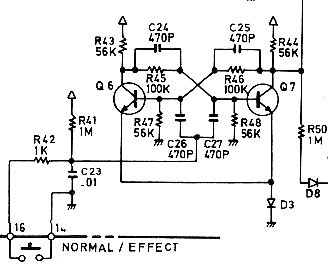
Ibanez:
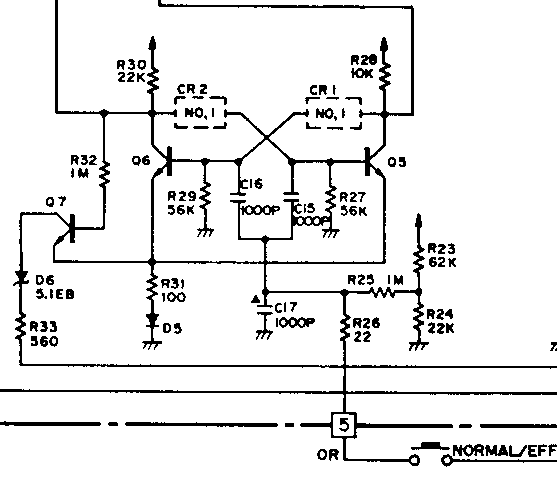
As it is visible Ibanez schem is intentionally asymetric in the value of collector resistors point of view!
Laurie,
As my lesson learn from Ibanez you can change the value of resistor in one of place of two collector resistors!
cheers |
Edited by - ssanyee on 05/10/2008 16:26:44 |
|
|
| |
Topic |
|




 Mods to flip-flop so pedals power up "ON"?

