| Author |
 Topic Topic  |
|
bossarea
Forum Admin

United Kingdom
3652 Posts |
 Posted - 03/26/2008 : 18:48:28 Posted - 03/26/2008 : 18:48:28


|
There's a few expressions that is often used when we talk about older pedals. New members might find an explanation of these terms useful.
Silver screw or black screw
The screw we're talking about is the one holding the battery cover. It is also commonly referred to as the thumb screw. From 1977 to mid 1981 this
screw was silver coloured. This screw had a slot and could be unscrews using a coin or screwdriver. In 1981, Boss decided to replaced the silver screw
with a black thumb screw without the slot. The black screw has been used ever since. There are different versions of both the silver screw and the black
screw. The screw head differ slighly in width and depth but all screws has the same threading and can be interchanged. The silver screw is also referred
to as metal screw while the black screw is sometimes referred to as plastic screw. Both screws are made of metal but the black screw is made black by
coating it with a black rubber-like material that can sometimes give the impression that the screw is made of plastic.

Pedals available with silver screw:
OD-1
PH-1
SP-1
GE-6
DS-1
CS-1
TW-1
NF-1
SG-1
CE-2
BF-2
PH-1r
SD-1
The change from silver screw to black screw occurred around the same time that the serial number changed from 4 digit ink stamped numbers to 6 digit
stickers in the battery compartment. It is very common to see pedals witth unoriginal silver screws. If in doubt, check the serial number. If it is a
4 digit number, the screw is original. If it is a 6 digit number and starts with 0, it might be original. Otherwise it is most likely an unoriginal screw.
The bottom label will on silver screw pedals contain the text "use a coin to open battery compartment lid when replacing battery" (type 1 label). When the
black screw was introduced, the label stayed the same for some time. For pedals with serial number higher than 14xx00, you will instead see that the label
text has been replaced with "Unscrew using your fingers to open battery compartment lid when replacing battery" (type 2 label). You can see pictures of the
different labels in the label gallery
Temporary LED
When you press the pedal switch, the LED usually lights up and stays lit while the effect is on. Press the pedal again and the LED and effect turns off.
This was not how the earliest Boss pedals worked. To save battery power, Boss decided to light the LED only when the pedal switch was pressed down. These
pedals are commonly referred to as temporary LED while the later pedals are referred to as permanent LED. Temporary LEDs was only found on the earliest
Boss pedals and was replaced with the permanent LED feature around serial number 9000-9100 (4 digit serial numbers start at 6400 and ends at 0500).
Clear Switch or Black Switch
When you open the battery compartment, you can see the switch that turns the pedal on or off. In the beginning this switch was made from clear transparent
plastic. Later on the switch was replced with a black switch. The clear switch is also referred to as transparent switch. The clear switch can be found on
pedals with serial numbers lower than 8500-8600.

Long or short dash
The font used on the early Boss pedals was at some time changed fractionally. This led to a slightly different appearance of some pedals. The picture below
shows a short dash and long dash version DS-1 together. Note how the D in DS-1 is directly underneath the i in Distortion for the short dash version and
directly below the t on the long dash version.

The long dash can be found on pedals with serial number lower than 15xx00. Some pedals like the BF-2 was made before and after serial number 15xx00 but was
never produced with the long dash font.
The pedals available in both long and short dash versions are the
OD-1
DS-1
CE-2
TW-1
PH-1r
NF-1
|
|
|
sp-1
Platinum Member

Germany
1454 Posts |
Posted - 03/26/2008 : 19:18:55
|
The NF-1 was also available in long and short dash versions.
Great info by the way  |
 |
|
|
Laurie
Double Platinum Member

Canada
4854 Posts |
Posted - 03/26/2008 : 19:54:32
|
| Wow! Bossarea, phenomenal post! You rock mate! |
|
|
|
bossarea
Forum Admin
United Kingdom
3652 Posts |
Posted - 03/26/2008 : 20:24:14
|
quote:
Originally posted by sp-1
The NF-1 was also available in long and short dash versions.
Great info by the way
Thanks, was thinking my list looked too short. Will edit my first post. |
|
|
|
ssanyee
Silver Member

Hungary
288 Posts |
Posted - 09/17/2008 : 11:17:08
|
quote:
Originally posted by bossarea
The long dash can be found on pedals with serial number lower than 15xx00. Some pedals like the BF-2 was made before and after serial number 15xx00 but was
never produced with the long dash font.
Is it also can be true for GE-6 (mine SN:10100)?
cheers |
|
|
|
starr36
Platinum Member
Canada
1172 Posts |
Posted - 09/22/2008 : 02:13:21
|
| - also to note, some early 'long dash' pedals have more rounded corners on the top of the case where the audio pots are mounted. the radius was shortened probably the same time they switched to the black screw, but I have no idea when |
|
|
|
kelmaur
Gold Member

USA
505 Posts |
Posted - 02/06/2009 : 03:13:21

|
so, appearance wise
what can you see on the pedal to determine if it is an oldr or newer one
the dash?
the serial number?
the screw? |
|
|
|
bossarea
Forum Admin
United Kingdom
3652 Posts |
Posted - 02/06/2009 : 08:39:13
|
Yes, all of those 3 but there are a lot of other small details as well.
- Different types of knobs
- Insulator plate between PCB and bottom plate
- AC adaptor jack
- amount of visible thread on the input jacks
- component changes
- component date codes
- label differences
- even the box has gone through some changes
- and probably some that I've forgotten...
For different pedals, there are different things to look for. The serial number is most important and if it's still there, we can usually determine exactly when it was made. |
|
|
|
Vim Fuego
Gold Member
Denmark
566 Posts |
Posted - 09/13/2009 : 21:58:32
|
quote:
Originally posted by bossarea
Later on the switch was replced with a black switch. The clear switch is also referred to as transparent switch. The clear switch can be found on
pedals with serial numbers lower than 8500-8600.
I actually have a DS-1 serial 8800 with a clear switch:
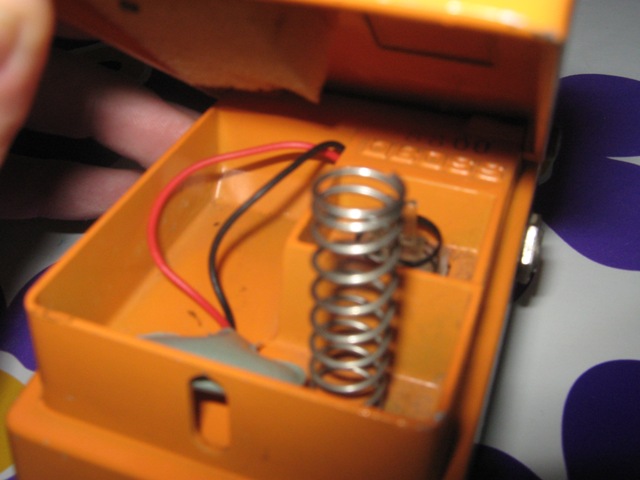
Cheers  |
Edited by - Vim Fuego on 09/13/2009 22:00:32 |
|
|
|
verivorax
Platinum Member
Canada
1185 Posts |
Posted - 10/11/2009 : 05:25:33
|
Just today I got a little obsessive and started to chart all the changes in circuit and appearance.. forgot about this stellar thread!
I'd still like to see a list (and I might continue my mission) which states the latest known serials for each feature - including Raytheon chip discontinuation, the NEC 14-pin chip duration, the change from "touch" to "t-wah", DM-2 chipset and accompanying font change.. is it all too much???
The #8800 clear switch is interesting too.. I wonder if there are more examples? |
|
|
|
hateandwar
Gold Member
Australia
524 Posts |
Posted - 10/27/2009 : 09:21:54
|
I just bought a Long Dash DS-1 , serial number 0300 (1981)
Is it supposed to have a siver screw? i think what i understand from this that its not supposed to have one... |
|
|
|
sp-1
Platinum Member
Germany
1454 Posts |
Posted - 10/27/2009 : 10:03:30
|
quote:
Originally posted by hateandwar
I just bought a Long Dash DS-1 , serial number 0300 (1981)
Is it supposed to have a siver screw? i think what i understand from this that its not supposed to have one...
"If it is a
4 digit number, the screw is original. If it is a 6 digit number and starts with 0, it might be original. Otherwise it is most likely an unoriginal screw."
I think it should have a silver screw |
|
|
|
hateandwar
Gold Member
Australia
524 Posts |
Posted - 10/27/2009 : 10:05:34
|
| Ah ha! Thanks alot SP-1 ! |
|
|
|
FenderStrat86
Bronze Member

USA
79 Posts |
Posted - 11/12/2009 : 19:46:08
|
Yes, really great detailed information provided. The only thing I ever noticed before was the silver screw/black plastic screw part. All my Japanese friends who had pedals back in 86' when I first started playing guitar with them had the silver screw versions of the pedals. When I started buying my pedals soon after, I noticed my new pedals had the black plastic screws instead.
One other difference I notice from the pix provided on this thread is that the battery wires seem to go into the pedal in a different area. On my black screw pedals, all the wires go into the pedal right above the black switch assembly, while the battery wires in the pix above, the battery wires goes into the pedal in a different location. Was that also a change in design for the overall Boss pedal line or is that just the case with the specific pedals pictured in this thread?
As you can see from the picture below that I took of one of my own Boss pedals (black screw version), the wires go into the pedal right above the black switch, which is different from the ones pictured above.
 |
Edited by - FenderStrat86 on 11/12/2009 19:54:08 |
|
|
|
chrissydamage
Silver Member
United Kingdom
180 Posts |
Posted - 11/30/2009 : 02:21:17
|
Yes well spotted-
the '1st era' pedals had silver screws/ink serials/clear switches and 2 cavities in the case with a blue battery snap
the '2nd era' pedals had black screws/paper serials/black switches and no cavities in the case with a grey battery snap
In between the 1st and the 2nd era there were many different sub periods each lasting sometimes less than a month where all the various changes appear to have been phased in gradually-
Certainly I've been seeing all kinds of weird and wonderful permutations of these pedals recently- particularly from late 1980 to 1981 which suggest to me a very brief period of 'use whatever parts are lying around'
Theres actually 2 different types of silver screw in existence as well- (a fat one and a flat one) just to confuse things even more :S |
|
|
|
FenderStrat86
Bronze Member
USA
79 Posts |
Posted - 11/30/2009 : 06:24:46
|
| Plus there is probably a percentage of Boss pedals out there that have been repaired such as a missing knob so instead of having a miss-matched set on the same pedal, they may have just changed all of them so they match. Or a late 80's black screw pedal was brought in for repair and the only parts they could find to do the repair was of early 80's Boss Pedal parts. Seeing a clear switch on a black screw pedal would definitely raise some eyebrows and no one would know why it was like that, except that perhaps it was repaired with old parts. |
|
|
|
Topic |
|



 Silver screw, clear switch and long dash

