| Author |
 Topic Topic  |
|
|
paisleyfender
Bronze Member

Germany
70 Posts |
 Posted - 07/17/2009 : 20:44:50 Posted - 07/17/2009 : 20:44:50


|
Hello everybody,
I have a CS-3 Compression Sustainer made in Dec 2007, which just yesterday suddenly stopped working when switched off.
That means the effect still works perfectly when engaged, all controls do what they are supposed to, but when switched off, no guitar signal is going through the unit at all, just total silence.
I already opened up the unit, to see if there are any loose cables, fried components or cold solder joints, but without any success.
Does anybody have some additional hint for me? What else can I look for (I'm not an electrician, just a technically interested guitar player)?
Thank you very much!
Greetings from Germany,
Markus |
|
|
Laurie
Double Platinum Member

Canada
4854 Posts |
Posted - 07/17/2009 : 21:22:35

|
G'day! I can take a look at the schematic for you on the weekend if someone else doesn't chime in before then 
This could be something like a bypass FET failure... |
 |
|
|
cctsim
Silver Member

United Kingdom
418 Posts |
Posted - 07/18/2009 : 00:46:54
|
Hi Markus,
The Q5 FET controls the bypass signal. Check at the gate electrode if you are getting the same dc voltage as at gate of Q4 when each FET is on. If that is the case then probably Q5 needs to be replaced.
 |
|
|
|
Laurie
Double Platinum Member
Canada
4854 Posts |
Posted - 07/18/2009 : 01:06:06
|
quote:
Originally posted by cctsim
Hi Markus,
The Q5 FET controls the bypass signal. Check at the gate electrode if you are getting the same dc voltage as at gate of Q4 when each FET is on. If that is the case then probably Q5 needs to be replaced.
But a word of "caution" about this test - you need a very high impedance volt meter for this to work. I have several meters but only my $300 Fluke can do this test |
Edited by - Laurie on 07/18/2009 01:06:29 |
|
|
|
Dr. Bob
Moderator

Australia
6593 Posts |
Posted - 07/18/2009 : 03:31:29
|
quote:
Originally posted by Laurie
quote:
Originally posted by cctsim
Hi Markus,
The Q5 FET controls the bypass signal. Check at the gate electrode if you are getting the same dc voltage as at gate of Q4 when each FET is on. If that is the case then probably Q5 needs to be replaced.
But a word of "caution" about this test - you need a very high impedance volt meter for this to work. I have several meters but only my $300 Fluke can do this test
Hi Laurie
How high an Input(Z) are you talking about?
10M ohm which is about standard for most decent Flukes, or something more like 100M(Z)?
I know a lot of the cheap sub $50 to $100 meters are about 1-2M(Z).
But thankfully for Chinese manufacturing, they are at least aiming for 10M(Z) minimum.
Regards Dr. Bob |
|
|
|
Laurie
Double Platinum Member
Canada
4854 Posts |
Posted - 07/18/2009 : 06:33:18
|
quote:
Originally posted by Dr. Bob
quote:
Originally posted by Laurie
quote:
Originally posted by cctsim
Hi Markus,
The Q5 FET controls the bypass signal. Check at the gate electrode if you are getting the same dc voltage as at gate of Q4 when each FET is on. If that is the case then probably Q5 needs to be replaced.
But a word of "caution" about this test - you need a very high impedance volt meter for this to work. I have several meters but only my $300 Fluke can do this test
Hi Laurie
How high an Input(Z) are you talking about?
10M ohm which is about standard for most decent Flukes, or something more like 100M(Z)?
I know a lot of the cheap sub $50 to $100 meters are about 1-2M(Z).
But thankfully for Chinese manufacturing, they are at least aiming for 10M(Z) minimum.
Regards Dr. Bob
The gate resistor is 1M, so it has to be in the 10M range. The cheaper meters are a lot lower than that. |
|
|
|
paisleyfender
Bronze Member
Germany
70 Posts |
Posted - 07/18/2009 : 08:29:50
|
Thanks very much for all your info!
@Laurie: what will happen if I only have a cheap multimeter? Will I damage anything or will I just not be able to do the measurement?
Then buying a expensive multimeter would of course be more expensive than buying a new (or used) CS-3.
Maybe I should just get me a replacement for the Q5 FET, and see if this is it? |
|
|
|
Laurie
Double Platinum Member
Canada
4854 Posts |
Posted - 07/18/2009 : 15:04:17
|
quote:
Originally posted by paisleyfender
Thanks very much for all your info!
@Laurie: what will happen if I only have a cheap multimeter? Will I damage anything or will I just not be able to do the measurement?
Then buying a expensive multimeter would of course be more expensive than buying a new (or used) CS-3.
Maybe I should just get me a replacement for the Q5 FET, and see if this is it?
Cheap meter just means you can't do the measurement. The easiest way to do it with a cheap meter is to measure at the "other" end of the gate resistor. Measure the voltage at the end of R19 that connects to R35. What is the voltage at that point when the pedal is on? How about in bypass? Also measure the DC voltage on pin 7 of IC1 - what do you get? |
|
|
|
paisleyfender
Bronze Member
Germany
70 Posts |
Posted - 07/18/2009 : 20:16:40
|
Strange things are happening, I just can't believe it.
I was about to follow Lauries instructions to do the necessary measurements, and so I opened up the CS-3, hooked up a battery, and connected with guitar and amp.
And what should I say, the bypass sound is there again!
The unit works as designed, no more issues. I then hooked up a 9V power supply, to get the same behaviour, effect and bypass sound ok.
How can this be? I'm very sure my first tests were done with correct cable connections and everything. Now I even shook the unit around, dropped it on the floor, just to see if there's a loose wire or solder joint anywhere, but without any result.
So I have to apologise, and thank you very much for your efforts, but there is nothing more to do here.
One happy user of a CS-3 again..
(By the way, I do like the CS-3 better than the CS-1 or CS-2, I tried them all, but this is a matter of taste, and a different story ;-)
All the best!
Markus |
|
|
|
paisleyfender
Bronze Member
Germany
70 Posts |
Posted - 07/19/2009 : 21:10:19
|
Ok, and now my next (and hopefully last) update on the health of my CS-3:
After my last post, I noticed that when I switched from effect to bypass, there was a short drop out of sound (about 1/2 s).
I wasn't sure if this was to be normal, but anyway...
And now I played some guitar again, and the CS-3 was faulty again, the sound again was gone when in bypass.
So I opened it up one more time, and then the error was sometimes there, sometimes not.
So I concluded that this definitely had to be a cold solder joint or a broken cable or anything like that.
If I pushed the PC board inside a bit, the bypass sound stopped, when pulling it out again, the sound was there again.
So I decided to touch all the solder points on the PC board to freshen up the connections, and to make long things short, this did the trick: the drop out was gone, the bypass now works absolutely flawless!
By the way, before that I tried to measure the above mentioned voltages, but at the gate of the Q5 it read 0 V, behind the resistor it was still 0 V, because when I touched the spot with my multimeter, the effect switched on, so it wasn't possible to measure the other state. I once held the footswitch down, and then got a reading of 8.6 V there.
On pin 7 of IC1 I got 6,7 V.
Best regards,
Markus |
|
|
|
FRANZONI
Double Platinum Member
Ireland
3543 Posts |
Posted - 07/21/2009 : 01:13:37
|
Thanks for coming back with how you finally fixed the problem... happy compressing..... another fan of the CS-3.... happy compressing..... another fan of the CS-3....  |
|
|
|
paisleyfender
Bronze Member
Germany
70 Posts |
Posted - 07/21/2009 : 08:57:44
|
Oh man, this CS-3 is driving me crazy!
Yesterday after work I wanted to play some guitar, and I just couldn't believe it, the CS-3 stopped working in bypass mode again!
OK, same game, I opened it up, connected to a wall wart, and two cables to guitar and amp, still no bypass sound.
I decided that I didn't resolder all joints in my first attempt, so I began here. And of course (?) the pedal worked just fine after this.
I put it together again, put it back in my BCB-60 board, and everything was ok.
This morning I was curious if it still worked, went to try the CS-3 again, and the bypass mode was dead again!!!
Tried a different wall wart, out of the BCB-60, no difference.
Now I have one more idea: my equipment is in a rather cold (19 degrees celsius) basement room. Could it be that the CS-3 is temperature or moisture sensitive? When I opened it up and resoldered the joints, maybe the temperature went up or the moisture down enough to let it work again.
What do you think? |
Edited by - paisleyfender on 07/21/2009 09:00:55 |
|
|
|
Laurie
Double Platinum Member
Canada
4854 Posts |
Posted - 07/21/2009 : 14:49:49
|
| Time for some photos of the board.. front and back, hi-res please |
|
|
|
paisleyfender
Bronze Member
Germany
70 Posts |
Posted - 07/21/2009 : 19:52:40
|
I checked the CS-3 once again, still no sound in bypass mode.
Opened it up, bent the PCB out for photos -> sound in bypass mode OK again!
Here are the requested pics (the solder work isn't the most beautiful one, I was already quite embarrassed by the situation and therefore impatient):
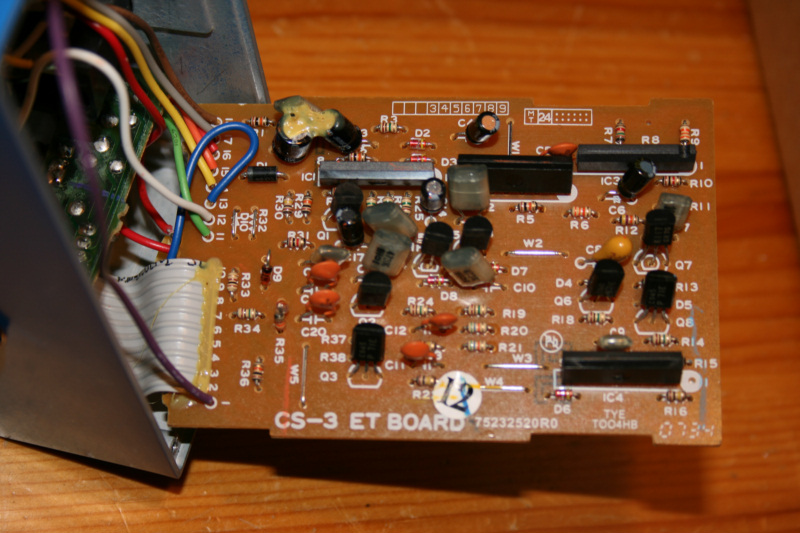
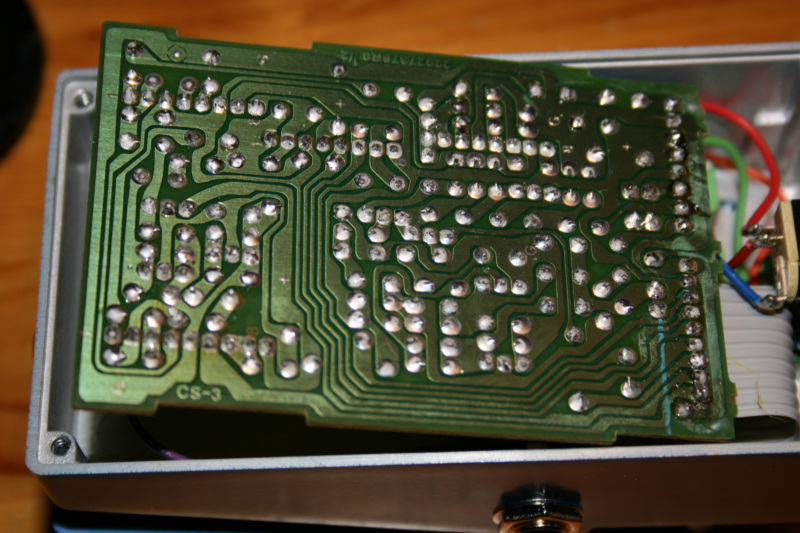
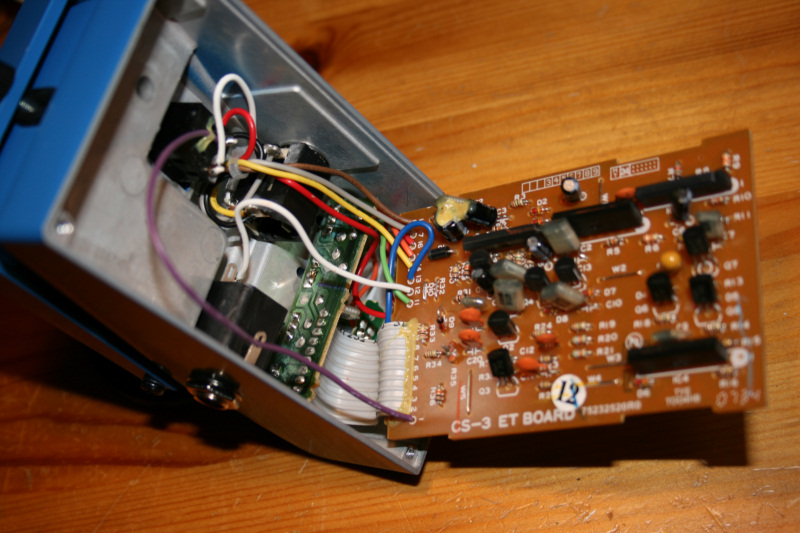
(by the way, why doesn't the upload window show the correct path? The folder "/forum/" is missing!)
|
|
|
|
Laurie
Double Platinum Member
Canada
4854 Posts |
Posted - 07/22/2009 : 06:19:01
|
quote:
Originally posted by paisleyfender
I checked the CS-3 once again, still no sound in bypass mode.
Opened it up, bent the PCB out for photos -> sound in bypass mode OK again!
Here are the requested pics (the solder work isn't the most beautiful one, I was already quite embarrassed by the situation and therefore impatient)
It almost has to be a dodgy wire connection, eh? Very carefully check the ends of the ribbon cable where they connect to the board. I've had a few pedals where everything looks fine, but one (or more) conductors in the ribbon were broken off where they entered the board.
Also give every wire termination a firm (but not too firm) wriggle - see if any come away.
Let us know if you find anything.
quote:
Originally posted by paisleyfender
(by the way, why doesn't the upload window show the correct path? The folder "/forum/" is missing!)
Yeah, it's a pain, but once you figure it out you get used to it |
|
|
|
paisleyfender
Bronze Member
Germany
70 Posts |
Posted - 07/28/2009 : 21:34:14
|
So, it seems I finally found the culprit:
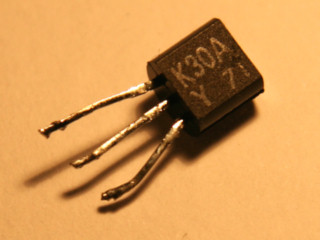
I just replaced Q5, and then the problem was gone (was it really?).
I even waited for one hour, and then tested the pedal again, to find it still functioning flawlessly!
Before that I had double-checked the ribbon connections as advised, to no success.
So the hint with the bypass FET failure hit the nail on the head.
Thank you again Laurie!
Thanks very much for your help to all of you!
So, and if the CS-3 will eventually continue to work fine, I can think about starting a new thread to take a closer look at the differences between MIJ and MIT CS-3s, or even CS-3, CS-2 and CS-1 pros and cons...
---
Update: and now the next episode in a never ending story...
The next day after the replacement of Q5 the problem was there again!
I then tried to resolder the joints on the ribbon that connects to the pot PCB, and noticed a cold solder joint on the level pot there.
And, as before, when I tested the pedal afterwards it worked just fine again.
Now I waited another day, to find that the sound is still there in bypass mode, but there is a very noticeable drop-out of almost one second when switching from effect to bypass. It seems that a capacitor has to load and this takes some time, before the sound is let through in bypass again!?
Any ideas?
I think I will give up on this pedal now, and sell it over eBay to one adept repairman to fix the problem.
I just bought a early Taiwanese CS-3 which has the dbx chip, and the sound of this model is by far superior to the newer 2007 model.
|
Edited by - paisleyfender on 07/29/2009 21:39:46 |
|
|
| |
Topic |
|
|
|




 CS-3 Compressor with no sound in bypass mode

