| Author |
 Topic Topic  |
|
DeFrag
Moderator

USA
3409 Posts |
 Posted - 02/29/2008 : 21:26:44 Posted - 02/29/2008 : 21:26:44


|
quote:
Originally posted by jack
I prefer Red Stripe...
Jamaican lager eh? Its not bad. |
 |
|
|
pedals 4 pv
Platinum Member

Canada
1351 Posts |
Posted - 03/01/2008 : 00:24:59
|
You guys didn't happen by any chance to be drunk when you bought these $100 guitar cables, cause my suspicions are rising. |
|
|
|
Laurie
Double Platinum Member

Canada
4854 Posts |
|
|
jack
Platinum Member
USA
1418 Posts |
Posted - 03/22/2008 : 16:22:06
|
Here's a link I found on the BYOC forum:
http://consumerist.com/362926/do-coat-hangers-sound-as-good-monster-cables
But here's the summary of the article:
Unknown to me and our 12 audiophile buddies, prior to the ABX blind test, he took apart four coat hangers, reconnected them and twisted them into a pair of speaker cables. Connections were soldered. He stashed them in a closet within the testing room so we were not privy to what he was up to. This made for a pair of 2 meter cables, the exact length of the other wires. The test was conducted. After 5 tests, none could determine which was the Monster 1000 cable or the coat hanger wire.
Kind of makes you think if you should replace your Monster Cables with heavy duty coat hangers... |
Edited by - jack on 03/22/2008 16:22:57 |
|
|
|
FRANZONI
Double Platinum Member
Ireland
3543 Posts |
Posted - 03/22/2008 : 18:02:37
|
I was looking at jo bonamassa on you tube and he was saying to just use a decent quality cable like a planet waves etc and this guy is a serious tone freak...he also uses a boss DD-3 for delay.... (some of the comments posted on the you tube clip were discussing what sort of 'studio delay' joe was using,if they had looked and listened a bit more joe actually tells you it's a boss DD-3.. (some of the comments posted on the you tube clip were discussing what sort of 'studio delay' joe was using,if they had looked and listened a bit more joe actually tells you it's a boss DD-3.. )..... i use the planet waves cables myself and i've found them to be pretty good and robust for constant gigging and rehearsing they are about 20 euro in the city for a 10/15 ft cable....... )..... i use the planet waves cables myself and i've found them to be pretty good and robust for constant gigging and rehearsing they are about 20 euro in the city for a 10/15 ft cable....... |
|
|
|
jack
Platinum Member
USA
1418 Posts |
Posted - 03/22/2008 : 18:15:46
|
quote:
Originally posted by FRANZONI
I was looking at jo bonamassa on you tube and he was saying to just use a decent quality cable like a planet waves etc and this guy is a serious tone freak...he also uses a boss DD-3 for delay....(some of the comments posted on the you tube clip were discussing what sort of 'studio delay' joe was using,if they had looked and listened a bit more joe actually tells you it's a boss DD-3..)..... i use the planet waves cables myself and i've found them to be pretty good and robust for constant gigging and rehearsing they are about 20 euro in the city for a 10/15 ft cable.......
I have been thinking about getting some Planet Waves cables in the future, because I figured if they are made/owned my the same company as D'Addario, they must be pretty decent. However, my current assortment of Conquest, ProCo, and Hosa Pro cables are holding up well for now... |
|
|
|
zentropa
Gold Member

USA
837 Posts |
Posted - 03/22/2008 : 18:16:02

|
most manufacturers have some high end cables that are thicker gauge, oxygen free, and with higher shielding.
the actual brand itself isn't really important as long as you can find the cable specs and match up the "better" ones.
from proco, the excalibur series.
from spectraflex, the super quads and fatso flex.
and so on.
i'm always sketchy on "lifetime warranty" on cables as often this just means it's more profitable to exchange out bad ones than making a good cable, but some are decent.
basically, you should expect to spend ~$35-45 for a 20' and ~$20-30 for a 10'.
cable grade does make a huge difference... whose name brand is on the cable doesn't.
monster has always kind of rubbed me the wrong way since i don't believe their monster rock, monster bass, etc. cables are a flat response as well as how badly they overcharge their HDMI cables heh.
|
|
|
|
Laurie
Double Platinum Member
Canada
4854 Posts |
Posted - 03/22/2008 : 23:48:08
|
I'm still on the "make your own" soapbox...
Buy some Neutrik connectors in bulk and "good" cable in bulk -zentropa has it bang-on - "cable grade does make a huge difference... whose name brand is on the cable doesn't", so it is necessary to spend a little more on the cable if you are making your own.
A 20 foot signal cable costs me about $20 to make. I've been making my own cables like this for 20 years and using them for band PA work and DJ work (plus for my own guitar playing at home), and I've never, ever, destroyed one.
|
|
|
|
zentropa
Gold Member
USA
837 Posts |
Posted - 03/23/2008 : 01:45:02
|
i also dig on making cables, but on occasion certain manufacturers do have barrel upgrades. unless you have a decent line on plugs, often it's not worth the difficulty to people of making your own.
high end cable is $0.40-0.55 a foot when bought at the consumer price level (read as: not at wholesale). plugs run anywhere from $2.50-$6 at the consumer price level.
often when i'm making a calculated cable decision, it's dependent upon how many cables i need, how much savings there are from making them, etc.
i enjoy the barrels/plugs on the excalibur cables as well as on super quads... as in, you can't get these on the open market. granted, you can't get the easily cracked plastic plugs/barrels on the low end monster cables and some of the planet waves, but you wouldn't really want to anyways. i assume the good plugs would be ~$5 ea.
20' cable = ~$10 for the cable itself, $10 for the plugs, $~4 shipping. sometimes i'm willing to spend $30 on a pre-made cable locally if it's of the same grade + lifetime warranty since i can just bring it back if it ever craps out and they do better a better job soldering/stripping and have heatshrink tubing on em.
when you start hitting the 1'-3' range of cables is when making your own has diminishing returns, since unless you bought say, 10 cables worth of materials and planned on making a few longer cables, you are likely paying $11-12 per cable and these can be bought pre-made for around the same price. (it's even harder to save money if the cables you want have right angle plugs)
the stuff i look for:
cable gauge: i want 20 gauge or fatter
shielding: i want 95% or higher
oxygen free: it's a plus.
plugs: as long as it's switchcraft, neutrik, or another major brand, they're usually solid.
if you are intent on making your own, there are sometimes some ways around it. the local guitar center here has a few employees that "get it" when i talk to em. if they don't give me the price i want i will either a) leave or b) find a different employee willing to play ball and let him get the sale. a while back i got 5 6" dual right angle cables for $3.80 each. read as: $1.90 ea. for decent right angle plugs (usually the cheapest you can find are ~$4.00 each).
good cables make a HUGE difference over cheap ones in terms of signal quality, tone, etc.
btw, most of the boutique guitar shops here stopped carrying monster cable since they were so embarassed at the number of warranty exchanges they were having to make, even though monster cable has a great margin on it. |
|
|
|
FRANZONI
Double Platinum Member
Ireland
3543 Posts |
Posted - 03/23/2008 : 09:06:02
|
quote:
Originally posted by lauries2
I'm still on the "make your own" soapbox...
Buy some Neutrik connectors in bulk and "good" cable in bulk -zentropa has it bang-on - "cable grade does make a huge difference... whose name brand is on the cable doesn't", so it is necessary to spend a little more on the cable if you are making your own.
A 20 foot signal cable costs me about $20 to make. I've been making my own cables like this for 20 years and using them for band PA work and DJ work (plus for my own guitar playing at home), and I've never, ever, destroyed one.
thats actually an excellent idea...... where would you buy a roll of guitar cable or what way is it sold in bulk and any recommendations as to brand....??.... i think i would be able to solder on a couple of neutrik connectors without burning myself too badly...... ......... ......... |
|
|
|
jack
Platinum Member
USA
1418 Posts |
Posted - 03/23/2008 : 13:28:05
|
quote:
Originally posted by FRANZONI
quote:
Originally posted by lauries2
I'm still on the "make your own" soapbox...
Buy some Neutrik connectors in bulk and "good" cable in bulk -zentropa has it bang-on - "cable grade does make a huge difference... whose name brand is on the cable doesn't", so it is necessary to spend a little more on the cable if you are making your own.
A 20 foot signal cable costs me about $20 to make. I've been making my own cables like this for 20 years and using them for band PA work and DJ work (plus for my own guitar playing at home), and I've never, ever, destroyed one.
thats actually an excellent idea...... where would you buy a roll of guitar cable or what way is it sold in bulk and any recommendations as to brand....??.... i think i would be able to solder on a couple of neutrik connectors without burning myself too badly...............
I know Belden is a brand of cable that people like to buy in bulk, but as stated, the name doesn't really matter as much as the specs do... |
|
|
|
Laurie
Double Platinum Member
Canada
4854 Posts |
Posted - 03/23/2008 : 16:44:32
|
quote:
Originally posted by FRANZONI
thats actually an excellent idea...... where would you buy a roll of guitar cable or what way is it sold in bulk and any recommendations as to brand....??.... i think i would be able to solder on a couple of neutrik connectors without burning myself too badly...............
G'day Franzoni!
I subscribe completely to zentropa's approach. The cable I'm using now came from my local electronics supply shop and is "no name" made in China - it is labelled "PROFESSIONAL LOW NOISE MICROPHONE CABLE". It is good quality, so I am using it happily.
In case anyone is interested, this is what I look for in a cable - I don't look at the electrical specs (if it conforms to the requirements below, it will be OK for audio). I've been doing it like this for a long time and haven't had any problems.
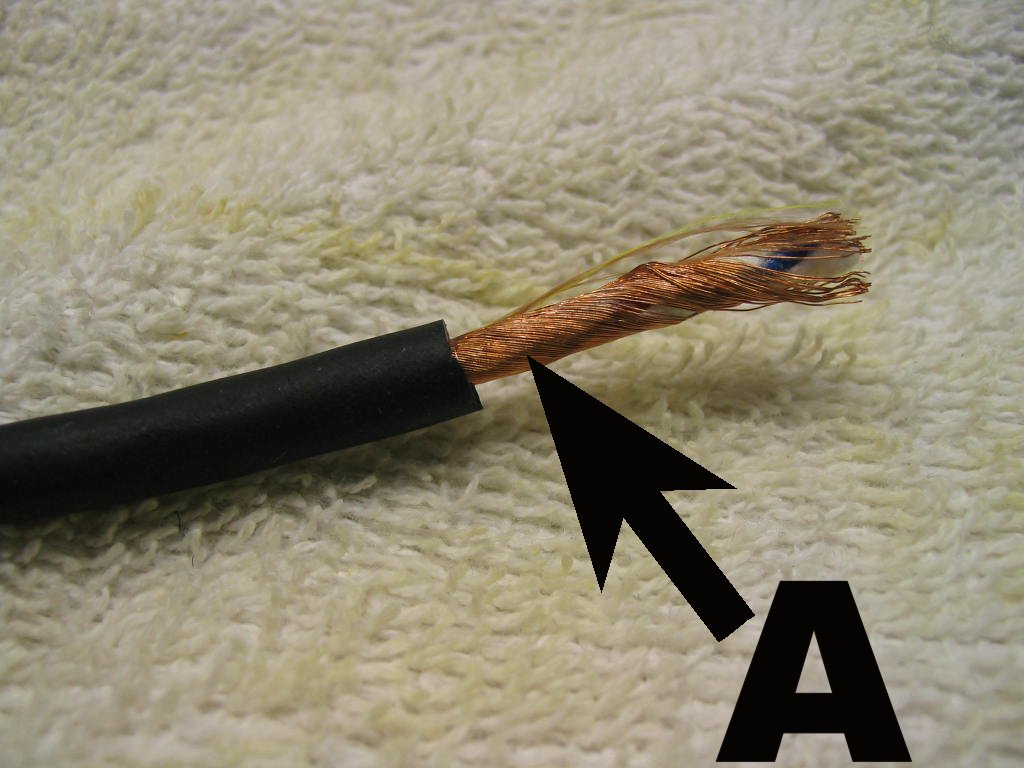
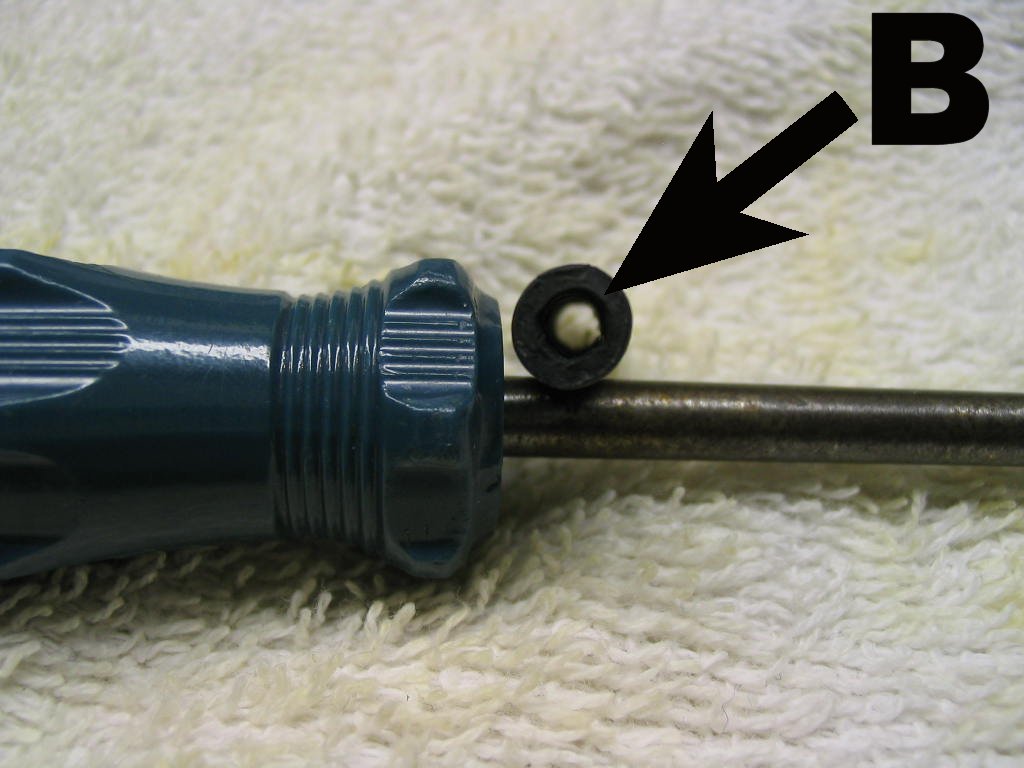
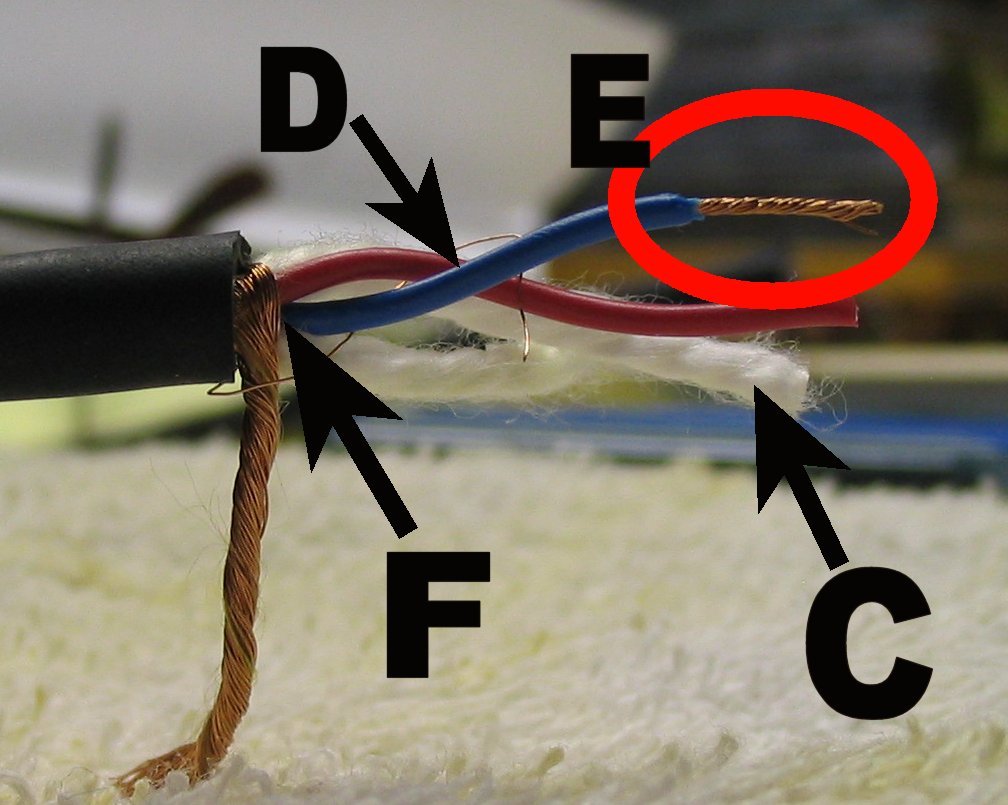
Referring to the pics below:
A) Ensure the shield completely covers the inner conductors like shown - this is the most important anti-hum attribute of the cable. The shield should be made of strands that aren't so thick they they break too easily - a good test is to unwind the strands and bend them back and forth and see if any break off.
B) The outer insulation layer needs to be thick enough and sturdy enough to take the "knocks". I've found what you see in "B" is about right. Some things to check:
- Is the total diameter of the wire right to fit into the audio connectors we use? (5-6mm or about 1.4 inch is good).
- Strip a piece of the insulation about 40-50 mm (2 inches) long and try to break it - twist it, bend it, scrape it, rub the cut ends on the ground. If it survives with little or no damage, it should be OK.
- Borrow a soldering iron and hold the tip on the insulation. It shouldn't "cut through like butter" - a slow melt is OK. No melt is better.
C) Ensure the cable has strain-relief cords. It looks like normal string/twine, but it's really strong - you shouldn't be able to break it without using tools. If the cable doesn't have this, it will fail from the mechanical abuse.
D) I use two conductor cable. Twise the stripped ends together and solder them both to the tip of the 1/4 inch jack - that way if one breaks, the other will still carry the signal.
E) Check the insulation on the signal wire conductors - it shouldn't be "paper thin". The thickness shown is about right. Also check that there are at least a dozen strands in the signal wires, and that it's not easy to break them - strip a small piece and bend the strands back and forward to see if any break off (be careful when you strip the wire to do this test - excessive pressure from the stripper can weaken the strands and they will break because of that).
F) A very important property of the signal wires is their resistance to heat - if the insulation melts when you are soldering, you will get a short at point F. To test this, strip the cable as shown in the pic with C,D,E,F in it. Use a soldering iron to "tin" the sheild, just like you would if you were about to solder it onto the 1/4 inch connector. Once the solder has cooled, check the insulation on the signal wires (the blue and red plastic in the pic). There should be no, or very little, marking on the insulation from the heat.
If the cable passes all that, I call it "good" and buy a bunch of it.
I buy my cable from the local professional electronics store (the "hobby" stores don't tend to carry it). If you are buying tens or hundreds of feet of cable off the reel (or the whole reel) and the store won't let you do these tests and support you while you do them, I'd recommend taking your business elsewhere.
A word on Neutrik connectors. They are traditionally made in Europe, and this type are UNFAILINGLY high quality (note I am in no way affiliated with Neurtik!). Neutrik have now come out with a range of "Made In China" connectors. I have started using them (they are cheaper) and haven't had any issues - but the jury is still out in my mind.
Anyway, hope all this helps!
Regards,
Laurie.
|
Edited by - Laurie on 03/23/2008 16:45:14 |
|
|
|
zentropa
Gold Member
USA
837 Posts |
|
|
Topic |
|



 Monster Cables

