| Author |
 Topic Topic  |
|
|
Laurie
Double Platinum Member

Canada
4854 Posts |
 Posted - 03/23/2008 : 16:59:22 Posted - 03/23/2008 : 16:59:22


|
I took the liberty of copying this post (originally in another thread) over into the FAQ. Bossarea, feel free to move/delete.
This post came from a discussion about making your own leads, and represents nothing more than my own rambling experience.
The cable I'm using now came from my local electronics supply shop and is "no name" made in China - it is labelled "PROFESSIONAL LOW NOISE MICROPHONE CABLE". It is good quality, so I am using it happily.
In case anyone is interested, this is what I look for in a cable - I don't look at the electrical specs (if it conforms to the requirements below, it will be OK for audio). I've been doing it like this for a long time and haven't had any problems.
Most electronics supply shops will cut you a small piece to take as a sample, so you can try all this stuff at home.
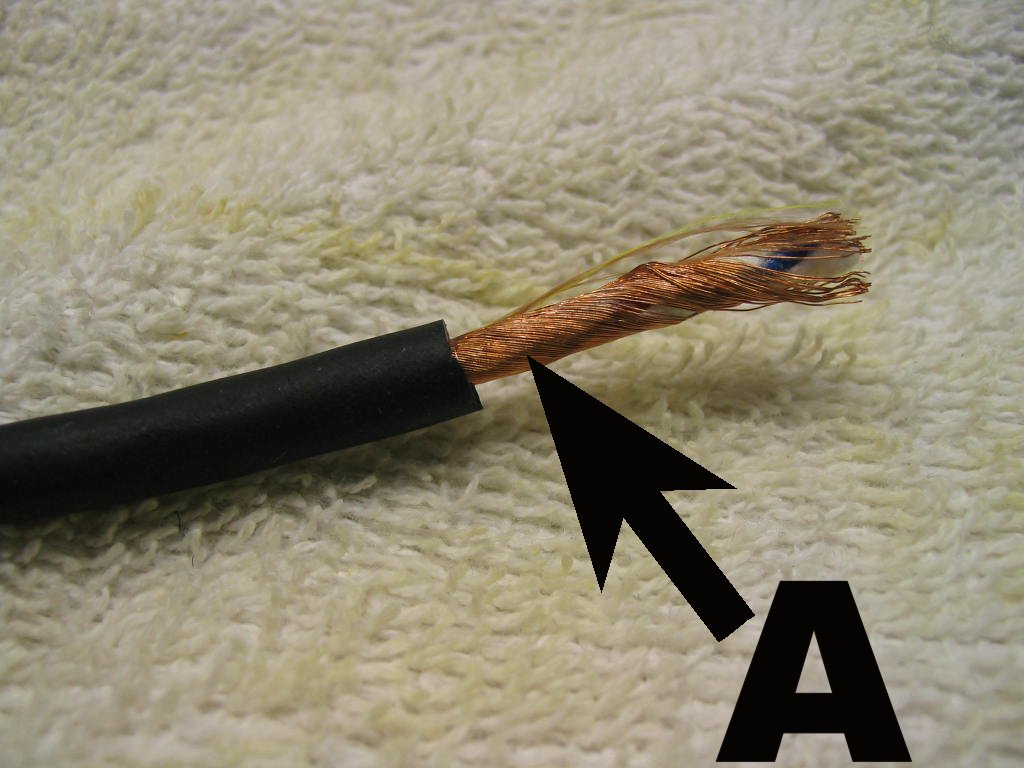
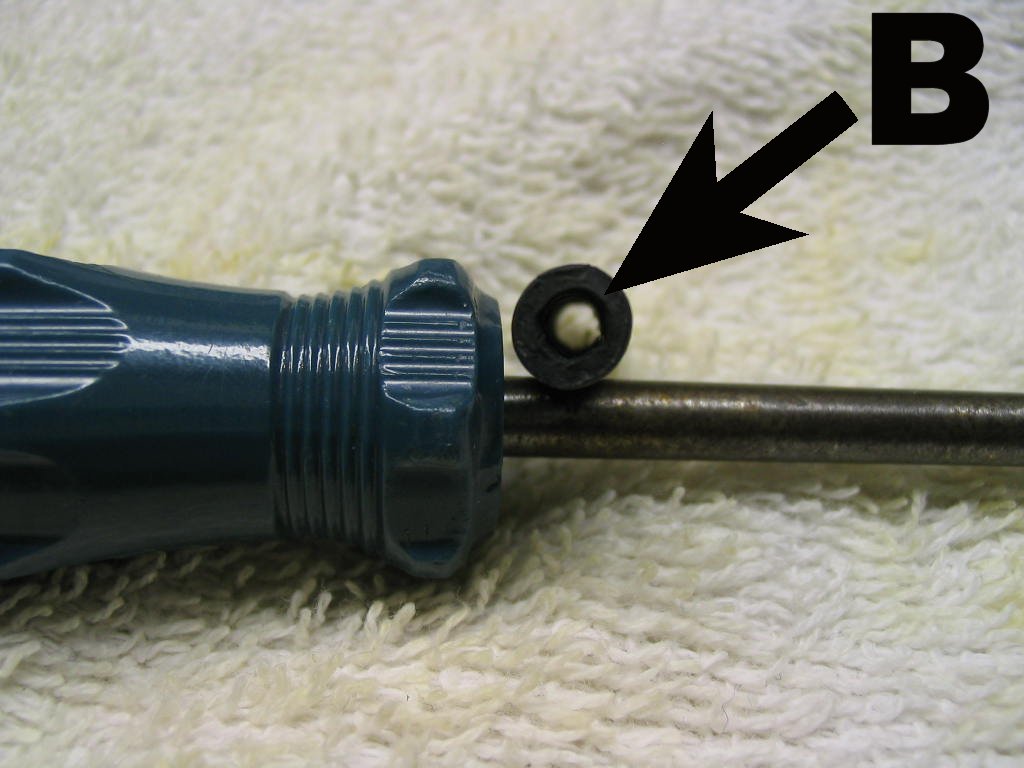
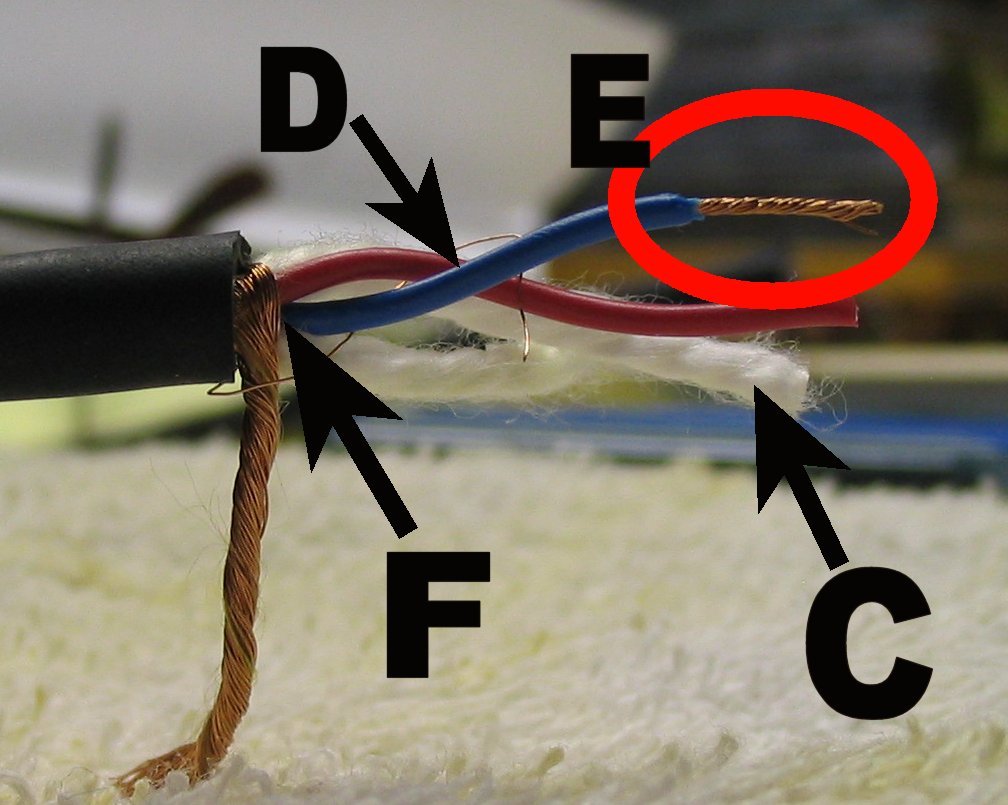
Referring to the pics below:
A) Ensure the shield completely covers the inner conductors like shown - this is the most important anti-hum attribute of the cable. The shield should be made of strands that aren't so thick they they break too easily - a good test is to unwind the strands and bend them back and forth and see if any break off.
B) The outer insulation layer needs to be thick enough and sturdy enough to take the "knocks". I've found what you see in "B" is about right. Some things to check:
- Is the total diameter of the wire right to fit into the audio connectors we use? (5-6mm or about 1/4 inch is good).
- Strip a piece of the insulation about 40-50 mm (2 inches) long and try to break it - twist it, bend it, scrape it, rub the cut ends on some concrete. If it survives with little or no damage, it should be OK.
- Hold the tip of a soldering iron on the insulation. It shouldn't "cut through like butter" - a slow melt is OK. No melt is better.
C) Ensure the cable has strain-relief cords. It looks like normal string/twine, but it's really strong - you shouldn't be able to break it without using tools. If the cable doesn't have this, it will fail from the mechanical abuse.
D) I use two conductor cable. Twist the stripped ends together and solder them both to the tip of the 1/4 inch jack - that way if one breaks, the other will still carry the signal.
E) Check the insulation on the signal wire conductors - it shouldn't be "paper thin". The thickness shown is about right. Also check that there are at least a dozen strands in the signal wires, and that it's not easy to break them - strip a small piece and bend the strands back and forward to see if any break off (be careful when you strip the wire to do this test - excessive pressure from the stripper can weaken the strands and they will break because of that).
F) A very important property of the signal wires is their resistance to heat - if the insulation melts when you are soldering, you will get a short at point F. To test this, strip the cable as shown in the "C,D,E,F" pic. Use a soldering iron to "tin" the sheild, just like you would if you were about to solder it onto the 1/4 inch connector. Once the solder has cooled, check the insulation on the signal wires (the blue and red plastic in the pic). There should be no, or very little, marking on the insulation from the heat.
If the cable passes all that, I call it "good" and buy a bunch of it.
I buy my cable from the local professional electronics store because the "hobby" stores don't tend to carry it.
A word on Neutrik connectors. They are traditionally made in Europe, and this type is UNFAILINGLY high quality (note I am in no way affiliated with Neutrik!). Neutrik have now come out with a range of "Made In China" connectors. I have started using them (they are cheaper) and haven't had any issues - but the jury is still out in my mind.
EDIT: I've just bought another 50 Chinese Neutrik connectors. No failures yet, but it's a little hard to keep the backs of the straight mono 1/4 inch plugs screwed tight - not enough of a problem to make me stop using them though. The right-angle mono 1/4 plugs seem to be very good though. I'm starting to really favour these - hard to beat for the price (just over $1 here in Canada).
Anyway, hope all this helps!
|
Edited by - Laurie on 04/27/2008 23:07:13 |
|
|
FRANZONI
Double Platinum Member
Ireland
3543 Posts |
Posted - 04/21/2008 : 17:35:45
|
Nice one laurie... i think you know my feelings on this..i agree 100%..i used to buy into the high end cable thing ,but i think a lot of it is audiophile phooey crossing over into guitar and general music gear.....especially live where your lucky to be able to hear yourself think about whats coming next sometimes.... so many of the classic tones from years back that(and me included) use for our base to work off were originally played and recorded with cables that we would consider sub standard now....look at the topic about fender koil kords..the whole curly lead thing....didn't bother brian may and he got great tone...could it be that the older cables letting less of the high frequencies through contributed to the tone....?? maybe forcng people to turn up the amps EQ to compensate and in the process creating the classic sounds we all know and love...?? i.e brian may and rory gallaghers use of treble boosters rather than just using the volume pot on the guitar....?? i think i might of posted this before,but i heard or read somewhere the SRV wouldn't use one of the high end cables in a studio once because he said it let too much electricity down into the amp.... or something along those lines.... a decent cable with some good connectors should be fine for most of us...unless eric johnson is a member of this forum..... i think you know my feelings on this..i agree 100%..i used to buy into the high end cable thing ,but i think a lot of it is audiophile phooey crossing over into guitar and general music gear.....especially live where your lucky to be able to hear yourself think about whats coming next sometimes.... so many of the classic tones from years back that(and me included) use for our base to work off were originally played and recorded with cables that we would consider sub standard now....look at the topic about fender koil kords..the whole curly lead thing....didn't bother brian may and he got great tone...could it be that the older cables letting less of the high frequencies through contributed to the tone....?? maybe forcng people to turn up the amps EQ to compensate and in the process creating the classic sounds we all know and love...?? i.e brian may and rory gallaghers use of treble boosters rather than just using the volume pot on the guitar....?? i think i might of posted this before,but i heard or read somewhere the SRV wouldn't use one of the high end cables in a studio once because he said it let too much electricity down into the amp.... or something along those lines.... a decent cable with some good connectors should be fine for most of us...unless eric johnson is a member of this forum..... ....... ....... |
Edited by - FRANZONI on 04/21/2008 17:39:14 |
 |
|
|
Laurie
Double Platinum Member
Canada
4854 Posts |
Posted - 04/27/2008 : 23:07:53
|
Part numbers for the Neutrik "China" connectors are: NYS207 for the right-angle, and NYS224 for the straight
|
|
|
|
Plush Pile
Bronze Member

Australia
93 Posts |
Posted - 07/10/2009 : 05:13:48

|
Sorry to bump an old thread...
Laurie i was wondering what your experience was like with the Neutrik china connectors was like a year later.
I've found some of the right angle NYS207 connectors at a good price and will pick them up if you've had no problems... |
|
|
|
Laurie
Double Platinum Member
Canada
4854 Posts |
Posted - 07/10/2009 : 05:18:18
|
Right angle ones are 100%. Nothing but praise for them.
Straight ones have a tendency for the back to unscrew if not tightened really well, but still good value. |
|
|
|
Plush Pile
Bronze Member
Australia
93 Posts |
Posted - 07/10/2009 : 09:56:30
|
Good to hear,
Thanks Laurie |
|
|
|
nathanscribe
Silver Member

United Kingdom
376 Posts |
Posted - 08/28/2009 : 21:02:29
|
Just to add my 2p -
I've found the same issue with those cheaper Neutrik straight & narrow jacks. I'm using mine with patchbays as well as pedals, and to be honest they're often coming slightly unscrewed during changeover. For this reason, I've stopped using them.
I now use Switchcraft straight mono jacks, and despite the extra expense, they're worth it. They're heavier, sturdier and stay tight. They're also pleasant to solder (well, as far as that's possible!).
For right-angles, I've not used Switchcraft as they're very expensive to buy in bulk - about £3.49 here each. So I tried some Amphenol cast right-angles and so far they're very good - compact (smaller than the r/a neutriks) and solid, and easy to work with. They can be obtained from Farnell here in the UK.
I've had mixed experience with various cables - one particular unbranded type smelt awful after a while for some reason - a really nasty rubbery smell that used to waft around the back of my equipment (stop sniggering!) and I replaced it with Van Damme, which has so far proved fine. |
|
|
|
zerksies
Double Platinum Member
USA
3406 Posts |
|
|
Laurie
Double Platinum Member
Canada
4854 Posts |
Posted - 10/01/2009 : 05:31:12
|
Interesting thing happened over the last week or so...
I had a friend over for a jam on Saturday and he remarked "that fender is pretty dark for a Fender". And that got me thinking. The Marshalls were sounding a bit off too. Low on volume and a bit sad on tone. I hadn't really noticed it until my mate brought my attention to it.
I just left it thinking "aural fatigue" but tonight it was shocking - boomy bassy Fender and really low output from the Marshalls. Happened with the 3 guitars I tried it with.
Took about an hour but I tracked it down to the main guitar lead - the one from the guitar to the HZD pedal I have at the head of the chain.
The lead measured the same resistance as a good one (about 0.2 Ohms), and the same capacitance as a good one (about 0.8 nF). But plug the sucker in and it killed the volume and tone. This is a lead bought from a local commercial maker and it has European Neutrik connectors, and they were well terminated. Should have been fine.
I cut 6 inches off each end of the cable and reterminated the connectors and cleaned everything with contact cleaner and viola, it's all good.
Never seen a cable go like this in 20+ years. No visible faults, and measures OK on test... yet kills tone. Then fixed by reterminating. |
Edited by - Laurie on 10/01/2009 05:33:31 |
|
|
|
jackderringer
Silver Member
USA
153 Posts |
Posted - 10/05/2009 : 04:51:53
|
| are the chinese right angle neutriks bulky? i'm hoping to put a bunch of them close together, spaced similarly to a patch bay. |
|
|
|
Laurie
Double Platinum Member
Canada
4854 Posts |
Posted - 10/05/2009 : 14:43:50
|
quote:
Originally posted by jackderringer
are the chinese right angle neutriks bulky? i'm hoping to put a bunch of them close together, spaced similarly to a patch bay.
Yes... they are pretty big. THat's their biggest draw-back. |
|
|
|
Pedal Dan
Silver Member
USA
419 Posts |
Posted - 01/07/2010 : 04:47:20
|
| Hi Laurie, I'm new to Bossarea. Just want to thank you for sharing the knowledge. I've learned alot from this site and hope I can add some of my experiences! |
|
|
| |
Topic |
|


 Cable for making your own leads


